
the third way
moving from emergency to emergence when worlds are falling apart

All flourishing is mutual.
~Robin Wall-Kimmerer
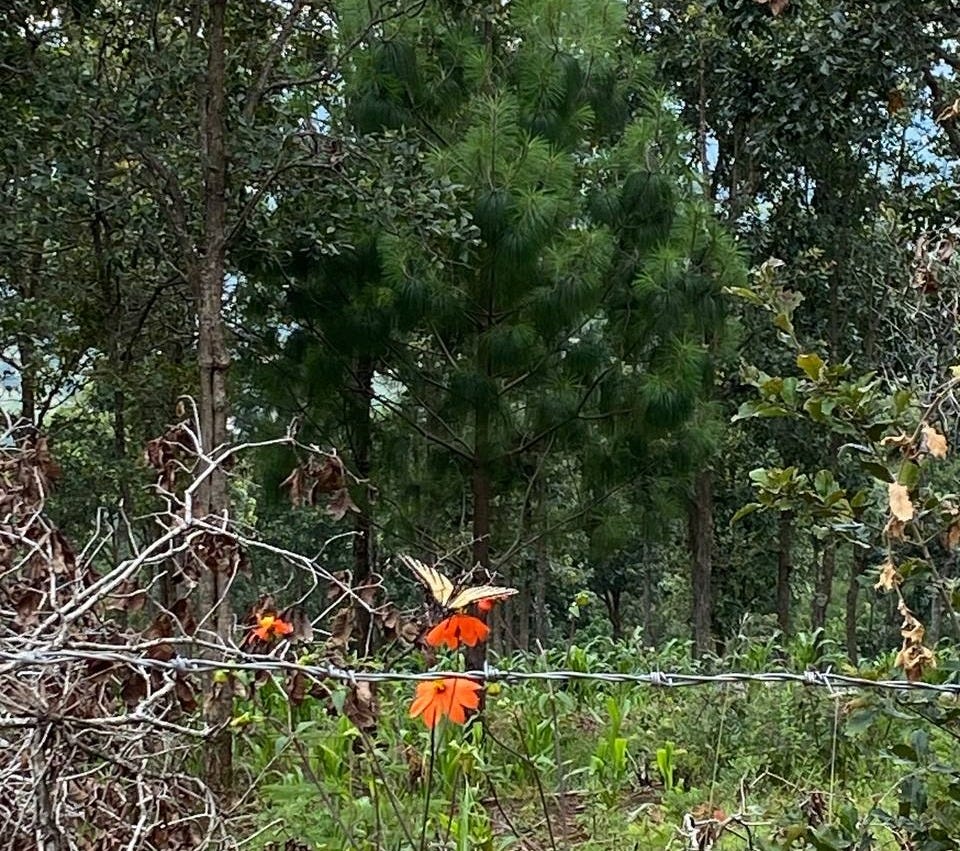
Take a breath and contemplate this sentence for a moment. Then take a look at this magnificent butterfly-flower-barbed-wire machine I found the other day.
I was always a very curious and deeply fascinated creature. I remember myself as a kid with a cute little head full of questions about literally everything. You would often find me playing in the garden, concocting something from plants, or hanging out for hours by myself, building entire universes from Lego. I always want to know how things are the way they are and why.
I first became aware beyond just passing thoughts, but as a fully embodied experience of the true scale and magnitude of the climate realities we are in, around 2018. I knew about it loosely since I was a teen, but I haven’t come to truly immerse myself in the actual data until much later.
And it broke my heart and filled me with fear.
Then, the pandemic hit in 2020, and while sitting at home without work, I witnessed the most bizarre collective landscape I’ve seen in my lifetime unfold and started developing a near obsession with exploring geopolitics and political theory, which led me, inevitably, to try and better understand the superstructure that is capitalism that seem to dictate so much of how our lives are oriented globally, socially and personally.
In October 2023, when the Genocide in Gaza started taking place, I had a whole life-altering political awakening underway.
I was for Palestinian liberation ever since I witnessed the brutal realities of the occupation with my own eyes during my mandatory military service, but I have never, to my great shame, been publicly vocal about it, even when I amassed a massive platform on social media around 2021. It wasn’t until 2023 that I realized, not just in theory but in the most visceral way possible, that everything is political and everything is connected.
That my work with sexuality cannot be separated from climate-genocide-collapse, that the fact that I grew up benefitting from a colonial project is inseparable from who I am and what I do, and that, more broadly, all liberation struggles are interwoven and caused by the very same devouring patriarchal-colonial-imperial-capitalist superstructures.
This awakening brought everything together for me, this time, without the fear and dread, only the heatbreak and burning Desire to act.
This year, I stopped putting any of my work behind a paywall and turned completely publicly funded when I realized that a) what I theorize about means nothing without radical implementation in how I move in the world, b) that my personal needs are inseparable from the needs of my immediate environment and the human-non-human collectives and therefore c) the best thing i should focuse on is building effective systems of free care beyond the logics of capital and the contro of the state with the money you all are giving me.
Here are the systems I am currently working on and how you can plug in. As I am building them, I am also using these essays to document the process itself and create blueprints that are useful to you all, but also the insight, muses, and lived experience of what it’s like to actively work on building new worlds.
Our default, immature responses to poly-crisis.
When I’m looking around, I notice two distinct responses to the realities of genocide, collapse, and the polycrisis: two options, both reasonable and valid as default, though neither is effective in addressing the complex, challenging reality we collectively and individually face.
Think about these not as hierarchical “stages” of development but rather modes we all come in and out of in our response to worlds in collapse.
The first mode that seems to be most prevalent is what we can call ‘numb-dumb and temporarily comfortable.’ These are those of us in positions of relative privilege who have the ability to continue participating in the current systems to a point where it’s possible, for now, to be “apolitical” and largely ignore the state of the world, the horrific realities of genocide, or the looming dangers of climate catastrophe.
When I think about an image that best describes this mode, this posture towards reality, I am thinking about cartoons when a character is being chased over a cliff and, for a few seconds, is suspended in the air while its legs are spinning rapidly, before falling into the abyss. Existence by sheer inertia.
The second mode can be called ‘imposed helplessness’ or ‘nihilistic-fatalism ’, it’s those of us, understandably so, who are looking the void straight in the eyes, who are bearing witness to genocide, understand that we are in a likely to inevitable mass extinction event and feel that it is too big, to impossible to change ot do anything about.
These are very valid responses to the sheer magnitude of what we are facing on all fronts and as effects of human and non-human life systems. We have simply not evolved to solve planetary-level problems.
This is why most modern therapists are unequipt to deal with and help people in the void of nihilism or support the sheer intensity of affects caused by facing collapse. This is also why the alternative I would like to suggest is not going to be a mere “feel-good” strategy, empty positivism, or another self-centered healing modality.
The third way is above all a survival strategy, a pragmatic guide, and a practice of affective, mutual flourishing amidst a polycrisis.
On Joyful Usefulness and moving from emergency to emergence
The third way could be called “Joyful usefulness”, but feel free to drop your made-up terms in the comment!
Joyful usefulness is an inherent sense of existential Joy that comes from making one’s life force, Desire, and creative libido useful.
Joy, unlike fleeting momentary happiness, is not a goal in itself; it is an effect of working towards an aim greater than the sum of our parts. Of
Making life an offering at the altar of creation.
And I mean this not in a self-sacrificial way, not as a form of martyrdom, quite the opposite; it is a stance that does not see oneself as in any way separated from one’s community, biosphere, and the whole.
There’s no need to believe in any greater order or transcendental goodness to see that when we build things that are useful, things we enjoy making, we come more fully alive.
We move beyond the binary of theory VS. praxis. We see how meaning is not inherent to things, neither in the biosphere nor in the culture-sphere; we are meaning-making machines. By relationally engaging with the world around us, by analyzing and theorizing about our reality, we literally make the world. Similarly, by taking action and building systems of care that make people less dependent on the state or capital to meet their needs, we are also producing new collective stories and ontological ways of becoming.
The task, if there’s one, is not to achieve some sort of perfect moral purity but to use whatever is in our disposal, with whatever, whoever, and however is available around us, and build actual things that change actual material realities for actual people.
Don’t ask yourself, “What does Yuval mean here?” Ask yourself, “What new worlds of meanings and affects am I actively producing by the way I am currently engaged with the world?”
It’s worth making a huge distinction here between talking about collapse and polycrisis and the prevailing apocalyptic mythology proposed by colonial Christianity. We talk not of an “end of the world” but a process of collapse and the constant becoming of new realities. Realities we are all actively shaping for better or for worse.
Joyful usefulness as a mature stance towards a more intentional response and responsiveness to living through a polycrisis. It is how we not only become much better prepared for the inevitability of catastrophe and drastic shifts in our lived experience, in the global order and supply chains, and in our social systems, but also how we thrive amidst that chaos.
Because again, all thriving is
Mutual.
"Numb, dumb and temporarily comfortable", brilliant!